%20hero.png)
People who work in Capitols love to visit other Capitols. We love to compare their architecture, admire their art, learn about their political processes, and talk shop with their staff. Perhaps best of all is when you can visit another state’s Capitol with a professional colleague, as I recently did with Cambray Baylis, Deputy Director of Education & History, while attending an east coast conference.
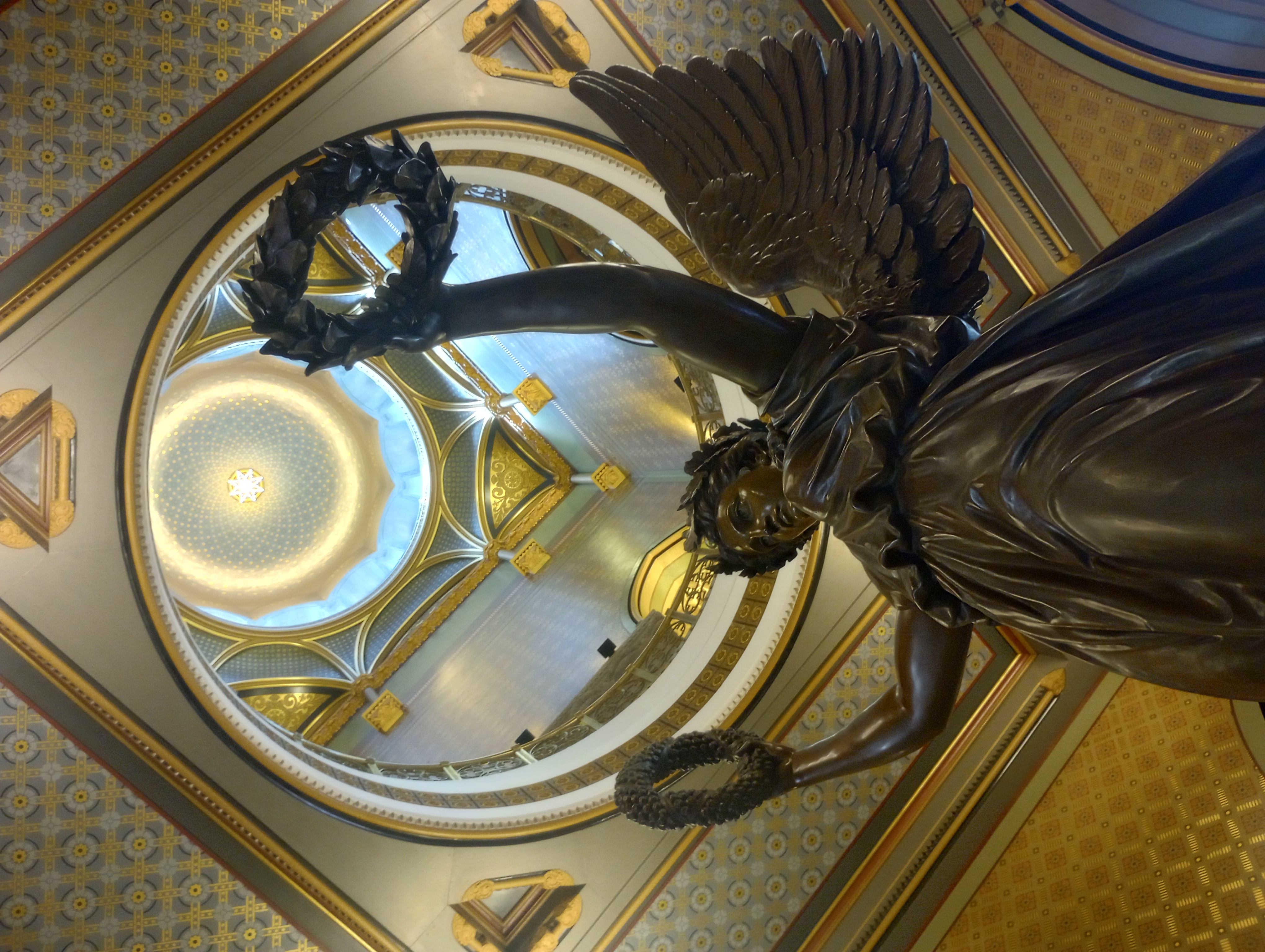
Cambray and I visited two Capitols—Rhode Island (Providence) and Connecticut (Hartford). I was particularly excited to see Connecticut’s building, which shares numerous commonalities with ours. In fact, I’ve come to think of it as Michigan’s “sorta twin” in numerous ways.
The process of commissioning, designing, and erecting Connecticut’s current Capitol spanned from 1871-1879—virtually the same window as our own. In fact, upon hearing that the Connecticut building commission rejected all the initially submitted plans, architect (and salesman) E. E. Myers offered them the chance to review his newly-adopted Michigan design. Within a week, the commission sent him a circular advertising for new plans, which he dismissed as having too quick a submission window. “Should your board see fit to extend the time until the final day of May or Middle of April, and then I will submit . . .” he responded. Ultimately, the contract went to church architect Richard M. Upjohn, who designed a glorious, if extremely unique, High Victorian Gothic building constructed of New England granite and marble, topped by a gold dome. It cost $2,532,524.24 to build, over a million dollars more than Michigan’s price tag.
A century later, in 1972, the U.S. Department of the Interior awarded the Connecticut State Capitol the designation of National Historic Landmark. Not long after, state officials began the process of restoring the Connecticut Capitol’s public spaces, including the legislative chambers. The project caught the attention of Michigan officials, including Secretary of the Senate Willis Snow. In 1988, Snow organized a two-day “technical information tour” for a handful of Senate staff and architects to learn about recent restoration projects at the New York and Connecticut State Capitols. While visiting each, the delegation met with other architects, facilities directors, computer technicians, lawyers, and legislative staff to learn about the legal and physical facets of each project.
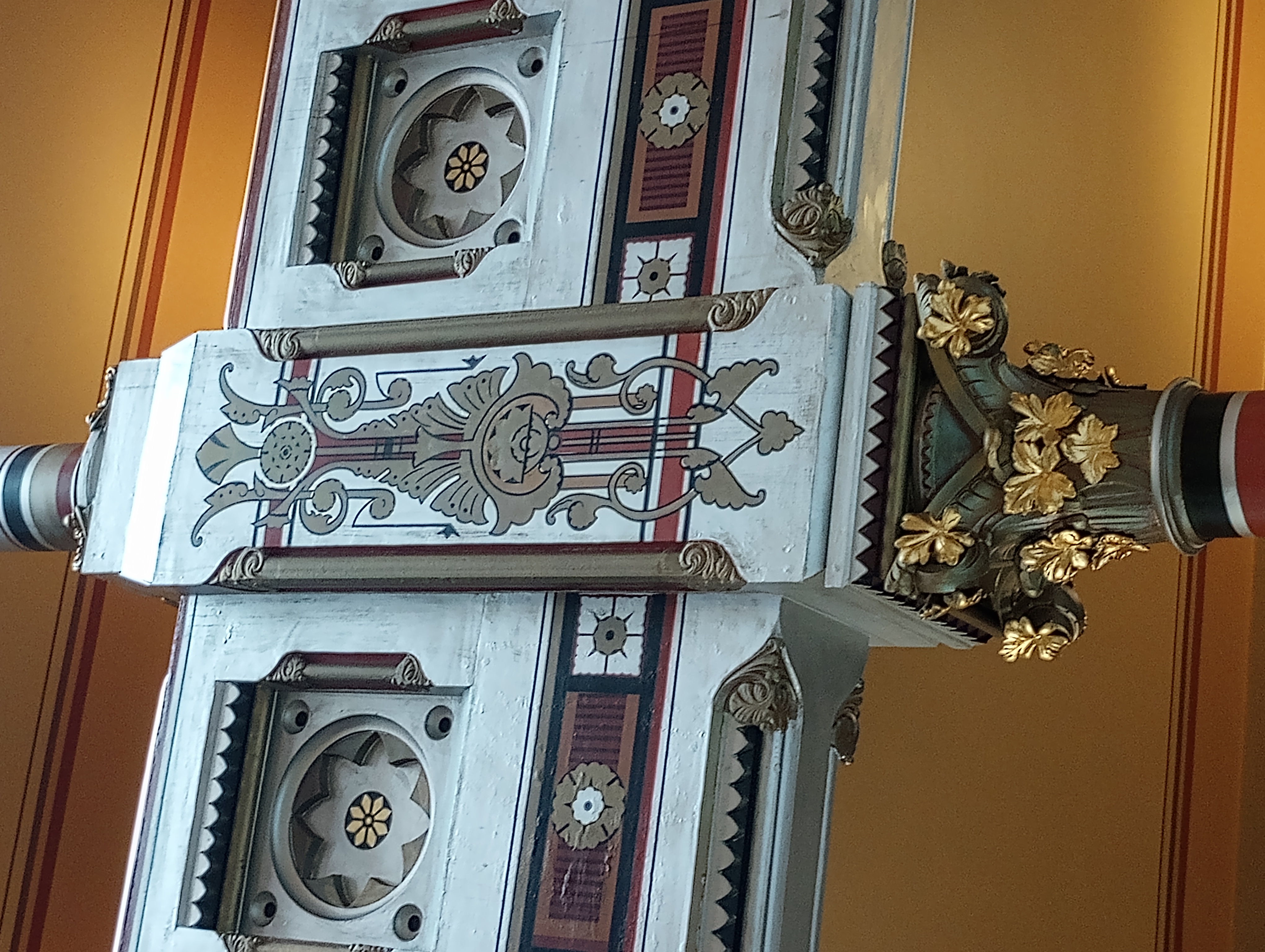
The Michigan entourage admired the Connecticut Capitol’s striking Aesthetic style decorative art, recently restored by the John Canning Company. Ultimately, the John Canning Company would end up winning several decorative paint contracts during the Michigan State Capitol’s 1987-1992 restoration, including the Senate Chamber. Canning and his namesake firm returned to Lansing for the 2023-2024 rotunda decorative art restoration. During this project, John sat for an interview in which he reflected on his work in both buildings. “It’s like—you’ve got twins, and which one do you favor? You know what I mean? Or grandchildren! . . . My wife . . . would answer the question: ‘the one that needs me the most.’ So, it’s like buildings! That’s kind of what favorites are.”
You can learn more about the evolving architectural style and history of our nation's capitol buildings by exploring our America 250 exhibit, Designing Democracy, on display in the east wing of the ground floor through summer 2027.
-Valerie Marvin, Director of Education & History
.jpg)
.png)