

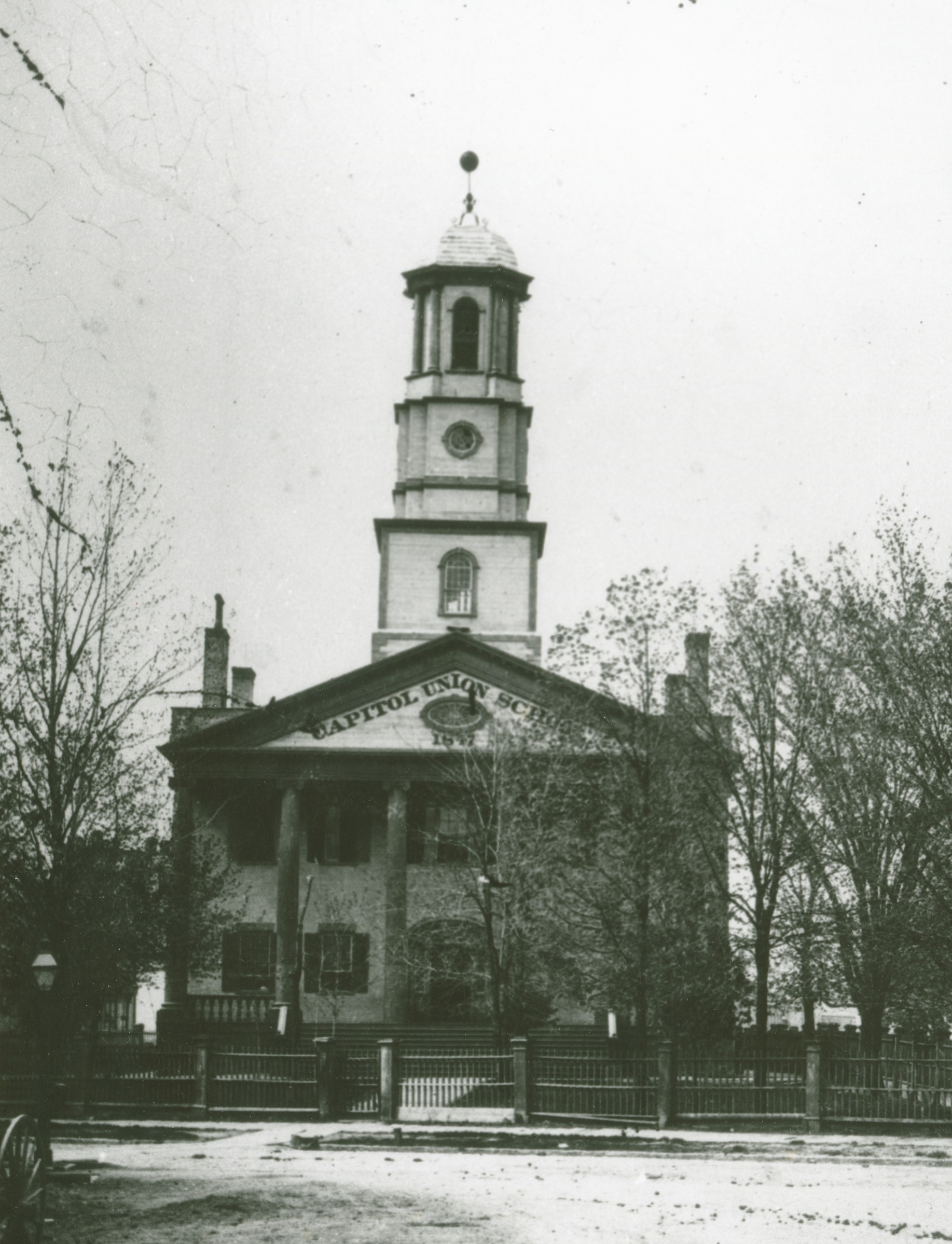
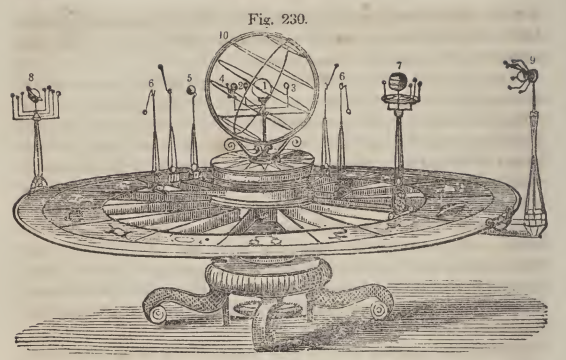
Michigan’s First Capitol, located in Detroit, was used as more than just a capitol building. As one of the largest buildings in the area, it was also used as a meeting space for various organizations, and as a lecture hall. In 1842, the citizens of Detroit were treated to a week long exhibition of Russell’s Planetarium. Russell’s Planetarium was a mechanical device (more accurately called an orrery) which modeled the solar system. It was built by James Russell of Columbus, Ohio. Russell had been studying astronomy since he was 18 years old and was in his sixties when he completed the orrery in February 1842. [1] It took him over two years to complete the planetarium and it was exhibited in Ohio before traveling to Detroit and many of the larger cities in the eastern United States.
In Detroit the mechanism was exhibited in the House Chamber on the first floor of the capitol building in August 1842. The planetarium was available for viewing from 9:00 until noon and 2:00-5:00. Admission was 25 cents. Each evening at 7:30, there was a special showing of the planetarium accompanied by a lecture. Some newspaper articles from the exhibition listed the presenter, so we know different presenters spoke in different cities. The Detroit papers list some of the topics, but do not name the lecturer. Detroit topics included lectures on the Earth which included an explanation of how tides work and a lecture on the Sun. Admission to the evening program was 50 cents. [2] This was a discount from the $1 admission cost in Cleveland.
Russell’s planetarium was notable because of its size, detail, and precision of mechanics. The Democratic Free Press in Detroit described the way the orrery worked “An idea may be obtained of the quantity of the machinery which it requires when it is known that there are in all eighty one different motions represented. The Sun has one motion on its axis; Mercury has 5; Venus 5; Earth 3; Moon 3; Mars 5; Jupiter 2; 4 satellites [sic] 3 each, 12; Saturn, with his rings, 4; seven satellites [sic], 2 each, 14; Herchell [Uranus] 3; 6 satellites [sic] 2 each, 12; four Asteroids, 3 each, 12; makingin all eighty-one separate motions, all produced by the turning of a single crank, with a force of 3 ½ lbs. Its gross weight is two tons.” [3] The satellites listed after the planets referred to their respective moons and a series of over 500 brass cog wheels allowed the moons to rotate around the planets, the planets to rotate around the sun, and all the bodies to pivot on their axis. [4]
In addition to showing the motion of the planets the planetarium could also be used to explain eclipses. The Democratic Free Press also described this “In the evening exhibition it [the sun] is represented by a strongly illuminated glass globe which scatters its ray through the whole system, and shows the shadows, eclipses, and transits of the planets innature.” [5]
After the Detroit exhibit was done, the planetarium traveled east and was exhibited extensively in New York. After a legal dispute regarding the rights to lecture with the planetarium, the orrery began to be used on lecture tours throughout the northeast including in Connecticut and Massachusetts. In the fall of 1844 newspapers around the country reported that Russell’s Planetarium had been destroyed in a fire at a theatre in Providence, Rhode Island.
[1] Works Progress Administration, Annals of Cleveland Volume 25 1842, pt 1 Cleveland Newspaper Digest p. 17.
[2] “Russell’s Planetarium” Democratic Free Press August 11, 1842;“Russell’s Planetarium” Democratic Free Press August 12, 1842; “Russell’s Planetarium” Democratic Free Press August 17, 1842.
[3] “Russell’s Planetarium” Democratic Free Press August 17, 1842.
[4] Silliman, The American Journal of Science and Arts Vol 42, New Haven, April 1842. p. 400.
[5] “Russell’s Planetarium” Democratic Free Press August 17, 1842.