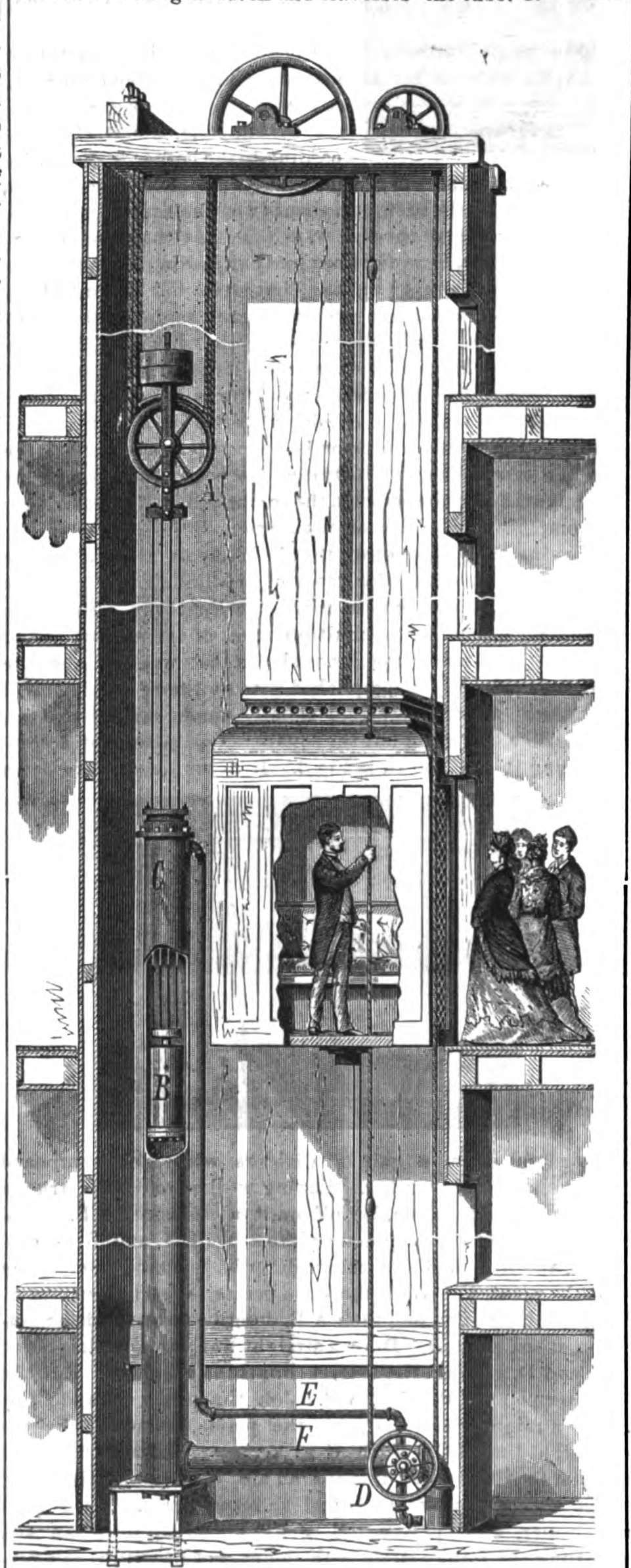
When our Capitol opened in 1879, one of the newest technologies included in the building was a small elevator in the north wing, just off the rotunda. Surprisingly, since the building did not yet have electrical power, the first elevator was powered by water!
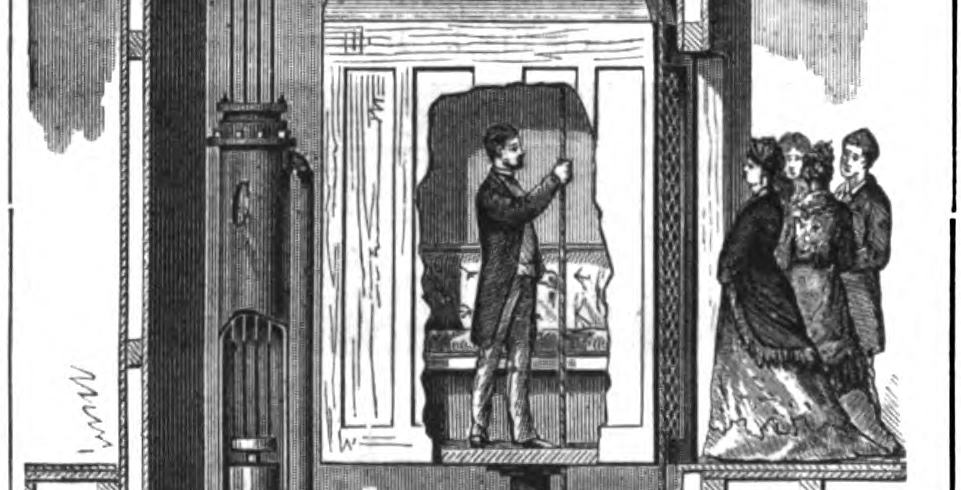
Created by W.E. Hale & Co. of Chicago, the Hale’s Duplex Water Elevator was powered by a vertical hydraulic cylinder tucked into the elevator shaft just behind the car. A piston inside the cylinder was connected to a hoisting cable system that held the car. A “shipper rope” attached to a control valve at the bottom of the shaft ran through the floor and ceiling of the car. The elevator operator would pull the rope up or down to allow water into or out of the hydraulic cylinder, raising or lowering the piston, which would then maneuver the car.
In the 1870s, passenger elevators were most often used in elite hotels and expensive department stores. These businesses, hoping to provide a comfortable experience for their customers, would often install a bench inside the car and hire elegantly uniformed operators. Unfortunately, at the Capitol, an elevator ride was not always a dignified experience.
Very quickly, the water elevator developed a reputation for losing power and stopping halfway up the building or sinking back down. Luckily, elevator safety devices called governors had been invented in 1853, so the car didn’t crash to the bottom of the shaft!
Elevator operators at this time had to know exactly how much pressure to apply to the shipper rope to bring the car level with the floors of the building. Additionally, with no electrical systems, there were no call buttons to bring the car to the correct floor. Many early elevators ran on a scheduled timetable, as was probably the case at the Capitol. Otherwise, passengers would have to shout up the elevator shaft to get the attention of the operator!
The Capitol’s first elevator struggled through about 20 years before it was electrified around 1900, and the water elevator became another piece of forgotten turn-of-the-century technology.